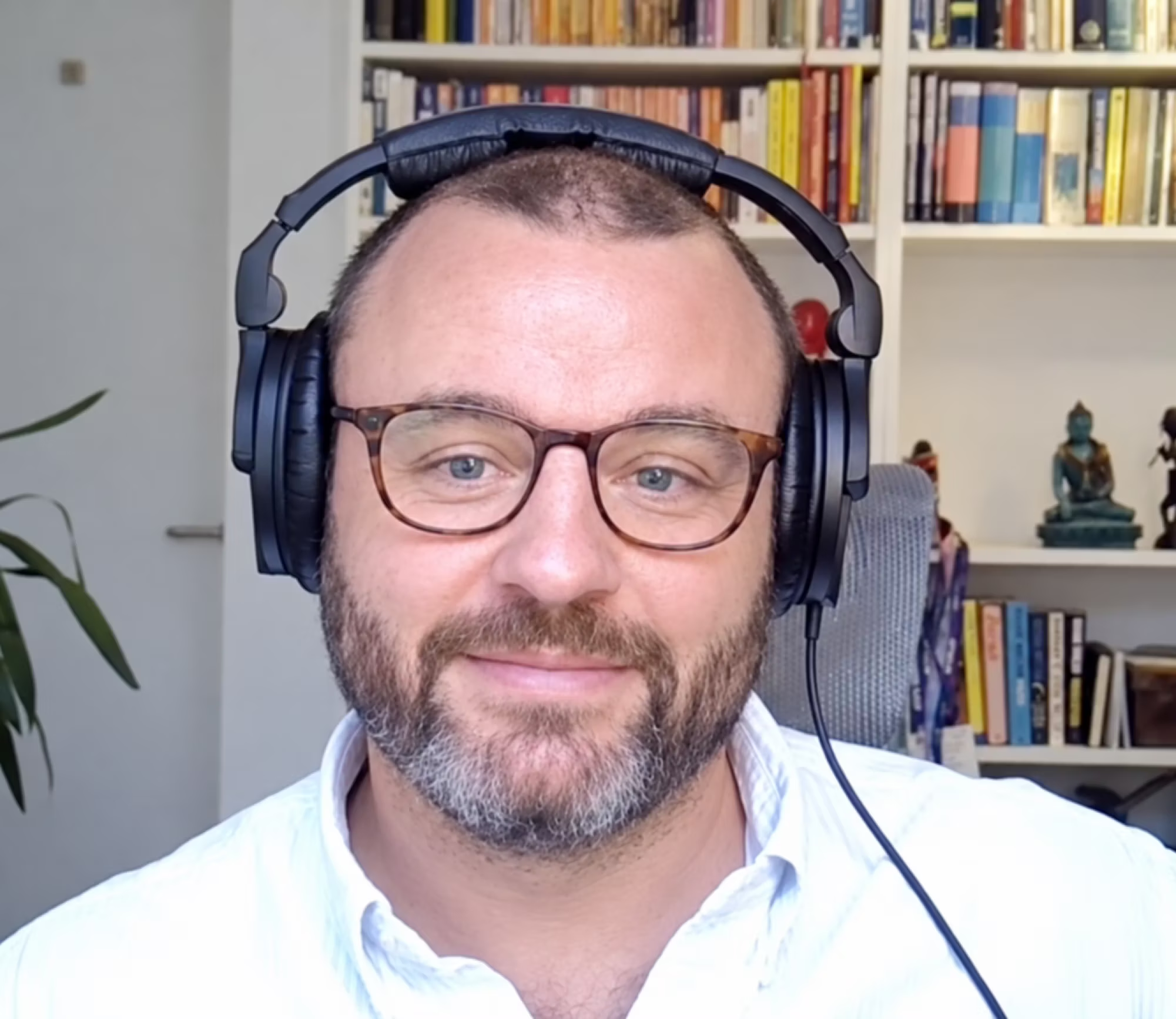
The story runs from a one-bedroom flat shared with a dog called Democracy, through a year and a half selling shots in London bars, to a conversation in a pub where her sister said she wanted to go back into hospitality and fix something that had bothered her for years: an industry still running on spreadsheets, pen and paper, and systems nobody on the floor wants to use. Her sister had spent her career as a loss prevention manager for one of the biggest food and beverage operators in UK stations and airports, where staff called her the "mind of the gap" lady because she always found where the money went.
Adi Hristova grew up in Sofia in the years after communism, in a neighbourhood of concrete blocks where the children played outside until their parents called them in. There were no mobile phones. There was football, basketball, tennis and fruit picked off the trees, and a one-bedroom flat shared with her sister and a dog her parents named Democracy.
She draws a straight line from that to entrepreneurship. In football you lose one day and win the next, and the only thing you control is turning up to the pitch and getting slightly better. Her parents ran one of Sofia's respected management consultancies, and in the lean post-communist years the whole family took on whatever work paid, including putting stickers on cars in bulk. Food in that flat was used so nothing went to waste, which is a detail she now finds oddly relevant to the company she built.
Adi came to the UK for a master's in sports management, having first been invited into Bulgaria's under-19 national football team at eighteen. She played one tournament, against England, and could not walk for a week afterwards.
In London she needed cash, so she handed out leaflets, and then took a job she describes as far outside her comfort zone: selling drinks in pubs, bars and nightclubs. She did it for a year and a half. What she took from it was not the money but an education in human behaviour: reading a room, working out how to approach different people, and spotting when the economics stop working. When the margin on the obvious seller got too thin, she brought in a shot nobody had heard of so curiosity would carry it. Rob's reading is that getting comfortable with rejection early is a founder skill most people avoid learning.
In Adi's own words, growyze is a profit protection platform for hospitality businesses: pubs, bars, restaurants, hotels, membership clubs, anywhere serving food and drink. It connects the back-of-house workflows that usually sit apart from each other: purchasing, deliveries, invoices, stock and wastage.
The losses it targets are rarely dramatic. They are admin errors, supplier overcharging, a box of rotten tomatoes invoiced as delivered, a broken bottle, two pints poured and never recorded, stock moved between a lobby bar and a restaurant with no record of the transfer. In an industry running on thin margins, strong revenue says very little about what is left at the end of the month. Many operators simply allocate a percentage of the business to loss and move on. Adi's question back to them is what happens when the real number is ten percent and they budgeted two.
Before the pandemic, Adi's sister asked her to meet at the pub. She was not happy, she wanted to go back into hospitality, and she had been thinking about a problem she had lived with for years.
She had started out working in a pub at Waterloo Station and worked her way up to loss prevention manager at SSP Group, the operator behind food and beverage outlets across stations and airports. Her job was to find out where businesses were losing money, and she was good enough at it that staff called her the mind the gap lady, with the implication that whatever had quietly gone missing was about to be found. She had once applied to Scotland Yard and made it as far as the presentation stage.
What she proposed over those pints was software that was easy to use, fast to adopt and affordable for the people actually doing the job, because hospitality was still running on spreadsheets, pen and paper, or systems too clunky and over-engineered for a busy floor. The sisters' skills were complementary, one from the corporate world and the investigative side, one from small businesses and the front line, and they joined forces.
Rob asked why, with so much hospitality software around, there is relatively little doing this. Adi's answer is that the problem itself is complex. The product has to stay simple for someone working a busy shift, which means the complexity moves to the back: dozens of small workflows that all have to connect and hold together, plus integrations with point-of-sale systems like Square.
Hotels are not a different problem, just a multiplied one. A lobby, a restaurant and a terrace are separate cost centres with stock moving constantly between them, and none of it is visible unless it is documented. The challenges are the same as a café or a restaurant; there are simply more of them.
The design principle she keeps returning to is operationally simple, financially powerful: capture the data easily on the ground, so that by the time a decision maker sees a report, the numbers are trusted and traceable to people who are accountable for them.
That split is the hard part of any operational product: a clean surface for people working at speed, and a lot of connected logic behind it. It is the same engineering problem we solve in web app development and in mobile app development, where the people using the software are rarely sitting at a desk.
Adi uses AI daily and says it has changed what she can get done: a week's work compressed into a day, and small internal tools she can build herself rather than waiting on resource. She is clear-eyed about why that works for her: she knows marketing, so she can tell the good output from the bad.
Inside the product, the approach is deliberately cautious. growyze is built on data, and as she puts it, garbage in, garbage out. Plenty of products lead with AI; she doesn't think customers care whether there is AI in it, only whether their actual problem is solved. She also recounts getting a support answer from a company's AI that was wrong and cost her money, which is now with the financial ombudsman, because the responsibility cannot be handed to the AI.
Her conclusion, and Rob's, land in the same place: AI is excellent in some areas, but you need an expert around whatever you are building. A solo founder vibe-coding a quick MVP is fine. The moment real users arrive, security, data protection and scalability need people who do this properly.
It is the argument we make in our own AI solutions work: AI is only as useful as the data and the engineering underneath it, and someone has to be accountable for the output. Our case studies show what that looks like once a prototype has to hold up in production.
Asked how she manages raising money alongside running the business, Adi says the thing she would change is having had a defined fundraising strategy five years earlier. As first-time founders, she and her sister focused on the problem and on building something useful, and treated fundraising as a separate activity rather than a parallel track.
The result is the familiar chicken and egg: investors want more traction, traction needs full focus, and a small team cannot give a hundred percent to both. She also makes the point that venture capital is only one route. Strategic partners, longer-term investors and grant funding are all open to founders who think about which kind of money actually fits what they are building.
On the co-founder question, her answer is unambiguous. Even with a hundred AI agents, you still need a sounding board and someone with the same skin in the game. Rob agrees from experience: the emotional support of having someone in the same boat through the hard stretches is worth more than the speed you give up.
Asked where growyze goes next, Adi describes building upward from the operational foundation that already exists. With trusted data underneath, AI features can help decision makers who find reporting hard to interpret, and that layer only works because of the operational groundwork below it.
The ambition she states is to be the go-to profit protection platform globally, for large operators and small ones alike, so that anyone in hospitality can hold on to their profit instead of losing it in parts of the business they cannot see. And if growyze were a song, it would be Queen's The Show Must Go On: turn up every day, keep going, put the pink glasses on and expect a better one.
growyze is a profit protection platform for hospitality businesses: pubs, bars, restaurants, hotels, membership clubs and any business serving food and drink. It connects back-of-house workflows including purchasing, deliveries, invoices, stock and wastage so margin leakage is caught before it reaches the P&L.
Adi Hristova co-founded the company with her sister just before the pandemic. Her sister had worked in hospitality since arriving in the UK, rising to loss prevention manager at SSP Group, and wanted to build something easy to use, fast to adopt and affordable for the people working on the floor, because the industry was still running on spreadsheets, pen and paper, and systems too clunky for a busy venue.
In the episode Adi points to admin errors, supplier overcharging, invoices for goods never received or received damaged, breakage, drinks poured and not recorded, wastage and theft. She notes that many businesses allocate a fixed percentage of the business to loss, and asks what happens when the real figure turns out to be far higher than the one they budgeted for.
Yes. Adi explains that hotels are more complex only because they have more cost centres (a lobby, a restaurant, a terrace) with stock moving between them. The underlying challenges are the same as a restaurant or café; the complexity is multiplied rather than different.
She says AI has significantly increased her own productivity and lets her build quick tools herself, but she is deliberately careful about where it goes in the product, because growyze runs on data and garbage in means garbage out. Her view is that end customers do not care whether a product uses AI, only whether it solves their problem, and that you need experts around whatever you are building.
Adi's position is that a solo founder building a quick MVP with vibe coding is fine, but once there are real users involved, you need an expert company to handle security, data protection and scalability. Rob adds that AI tools accelerate people who already know the domain and can tell good output from bad, and produce slop for people who can't.
She says that if she were starting again she would have had a clearly defined fundraising strategy from the beginning, run in parallel with building the product, rather than discovering it later. Rob adds that venture capital is only one route, and that strategic investment and grant funding are worth considering.
Adi's answer is yes: she would rather have a co-founder because you complement each other, and even a hundred AI agents don't give you a sounding board. Rob makes the same case from experience, pointing to the emotional support of having someone with the same risk and the same skin in the game.
LinkedIn is the best place to reach Adi directly, and the company is at growyze.com.
Adi Hristova is the co-founder of growyze, the London-based platform building the financial operating layer for hospitality, helping operators protect profit through verified operational data. She founded the company with her sister, who spent her career in loss prevention for major food and beverage operators.
Her twenty-year career spans innovation programmes across Europe, international business development and operational technology, and began with a degree from Bulgaria's National Sports Academy and a master's in sports management in London. Before any of that she played football for Bulgaria's under-19 national team.
Rob Woodhead is co-founder of Old.St Labs and host of The Humans Behind the Tech, the podcast about the people building technology businesses: where they came from, what shaped them, and what the journey actually looks like from the inside.


Lorem ipsum dolor sit amet, consectetur adipiscing elit, sed do eiusmod tempor incididunt ut labore et dolore magna aliqua. Ut enim ad minim veniam, quis nostrud exercitation ullamco laboris nisi ut aliquip ex ea commodo consequat. Duis aute irure dolor in reprehenderit in voluptate velit esse cillum dolore eu fugiat nulla pariatur.
Block quote
Ordered list
Unordered list
Bold text
Emphasis
Superscript
Subscript
Old.St Labs is a software design and development company based in London, building high-quality digital products for startups and established businesses across the UK and US.