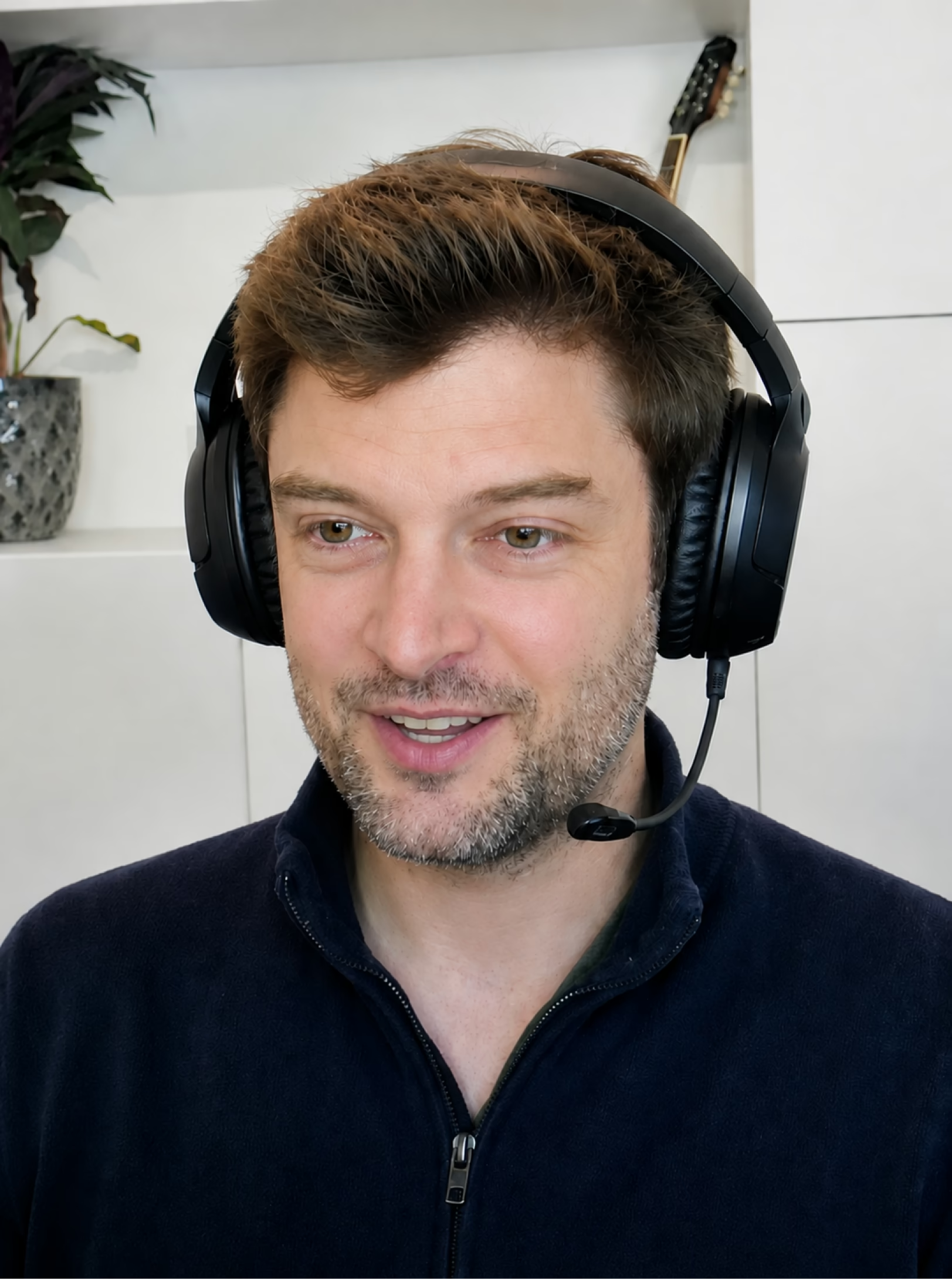
2026 has been called the Year of the Agent. Every major AI lab has released one: Gemini Spark, Claude Cowork, ChatGPT's Agent Mode, OpenClaw. In this episode of The One About AI, host Rob Woodhead is joined by Rob Lynch and Ben Burch to work out what actually separates an agent from a chatbot, why most of the real business value today sits in structured workflows rather than full autonomy, and where a small business should start.
A chatbot answers a question. An agent has access to tools and can act on what it finds. Rob Lynch draws the line plainly: a chatbot gives you an answer directly, while an agent can reach into a browser, a CRM, an ERP system or an internal database and do something with it.
Rob Woodhead's analogy is a guidebook versus a travel agent. A guidebook hands you information. A travel agent books the holiday, buys the ticket and sorts the logistics.
Ben Burch frames it as a multi-step capability. An agent can chain decisions together rather than stopping after one answer, so the task becomes define a destination and let it work toward that, rather than ask a question and get a reply.
Rob Lynch makes a distinction that matters more than the marketing does. Most of what gets called agentic in enterprise today is not a fully autonomous agent choosing its own tools. It is AI inserted at a specific point in a structured workflow: summarising a document, extracting data, classifying a request, routing an email.
His view is that agent simply sounds more exciting than AI-powered workflow, so the term has stretched to cover both. The practical implication for a business is that the safer, better-proven value in 2026 sits in that structured workflow category rather than in handing an agent free rein. Rob Lynch points to a client project his team has run in something close to this form since early 2023: a workflow that classifies dense academic documents and extracts and interprets data from them, a task that AI is well suited to because reading and understanding documents quickly is exactly what it is good at.
This is the same territory our Vibe Code Audit looks at: whether an AI-assisted build or workflow is genuinely solid under the hood, not just fast to stand up.
Ben Burch is direct about where not to start. OpenClaw is powerful but developer-centric and, in his words, open from a security perspective, so it needs someone who understands the implications of what they are setting loose.
Claude Cowork is the lower-risk entry point he recommends instead. It runs on the desktop, asks clarifying questions, prompts for permission before acting, and lets a non-technical user go from a single task to a finished output without needing to understand what is happening underneath. As Ben puts it, the experience strips away a lot of the obscurity: you ask a question or set a task, and you get an output.
The team's shared advice for a small business: start with a tool like Claude Cowork on one real, repeating task before considering a more open, developer-driven framework. You can see the kind of AI-native software builds this leads to across our client work.
Rob Lynch introduces a second lens that the agent conversation often skips. Automation replaces a task. Augmentation puts better tools and information in the hands of the people already doing the job, particularly senior staff and management.
Instead of pulling together a full team of juniors for input, a manager with the right AI tools has the relevant information already gathered from the internet, the team and the company's own databases, ready to interpret and present. Rob Lynch is clear that this side of the equation is easy to overlook because it is harder to put a single efficiency number on it, but it is where a lot of the real value sits.
Asked directly whether agentic AI is going to eat the agency's lunch, Rob Lynch's answer is measured: it will not replace the work, it will change what the work is, and it already has. His view is that agentic tooling and AI-native coding let a software agency offer more than it could a few years ago, mobile and web apps plus agents doing the work behind a lighter interface, without agents replacing the underlying value of understanding a client's business and building the right solution for it.
Ben Burch's caveat is the one worth sitting with. The small, repeatable tasks that junior staff traditionally cut their teeth on are exactly the tasks agents are best at absorbing, which raises a genuine question about how the next generation of senior people will build up their experience.
Ben also references a widely attributed Jeff Bezos idea: rather than fixating on what is about to change, work out what will not. Customers will always want a better product and faster delivery. Businesses will always need a human element to handle the part of the job that cannot be predicted in advance. Agents are very good at the part that repeats. The unpredictable part stays human.
Rob Lynch is a co-founder of Old.St Labs, a London-based AI software agency building web and mobile products for startups and scale-ups. He co-hosts The One About AI alongside Rob Woodhead.
Ben Burch is co-founder of Allegr, a community platform used by UK military regiments, veteran organisations and sports clubs, and a Technical Consultant at Old.St Labs. A former Oxford University Boat Club president and national squad rower, he has spent two decades working across e-commerce, financial technology and technical consulting.
Rob Woodhead is a co-founder of Old.St Labs, a London-based AI software agency building web and mobile products for startups and scale-ups. He hosts The One About AI alongside Rob Lynch.
A chatbot answers questions directly. An AI agent has access to external tools such as browsers, CRMs and internal databases, and can take multi-step action to complete a task rather than just respond to it.
Not usually. Most enterprise use in 2026 involves AI inserted at specific points in a structured workflow, such as summarising or classifying data, rather than a fully autonomous agent choosing its own tools and steps.
Claude Cowork is a practical, desktop-based entry point that needs little configuration, compared with more open, developer-focused frameworks such as OpenClaw.
Rob Lynch's answer: "No, but they will change what the work looks like. Ben Burch adds a caveat: agents are absorbing the small, repeatable tasks junior staff normally cut their teeth on, which raises a real question about how the next generation gains experience."
Watch Episode 2 now on YouTube or listen on Spotify.


Old.St Labs is a software design and development company based in London, building high-quality digital products for startups and established businesses across the UK and US.


.avif)